Reliable Heat for Every Production Stage
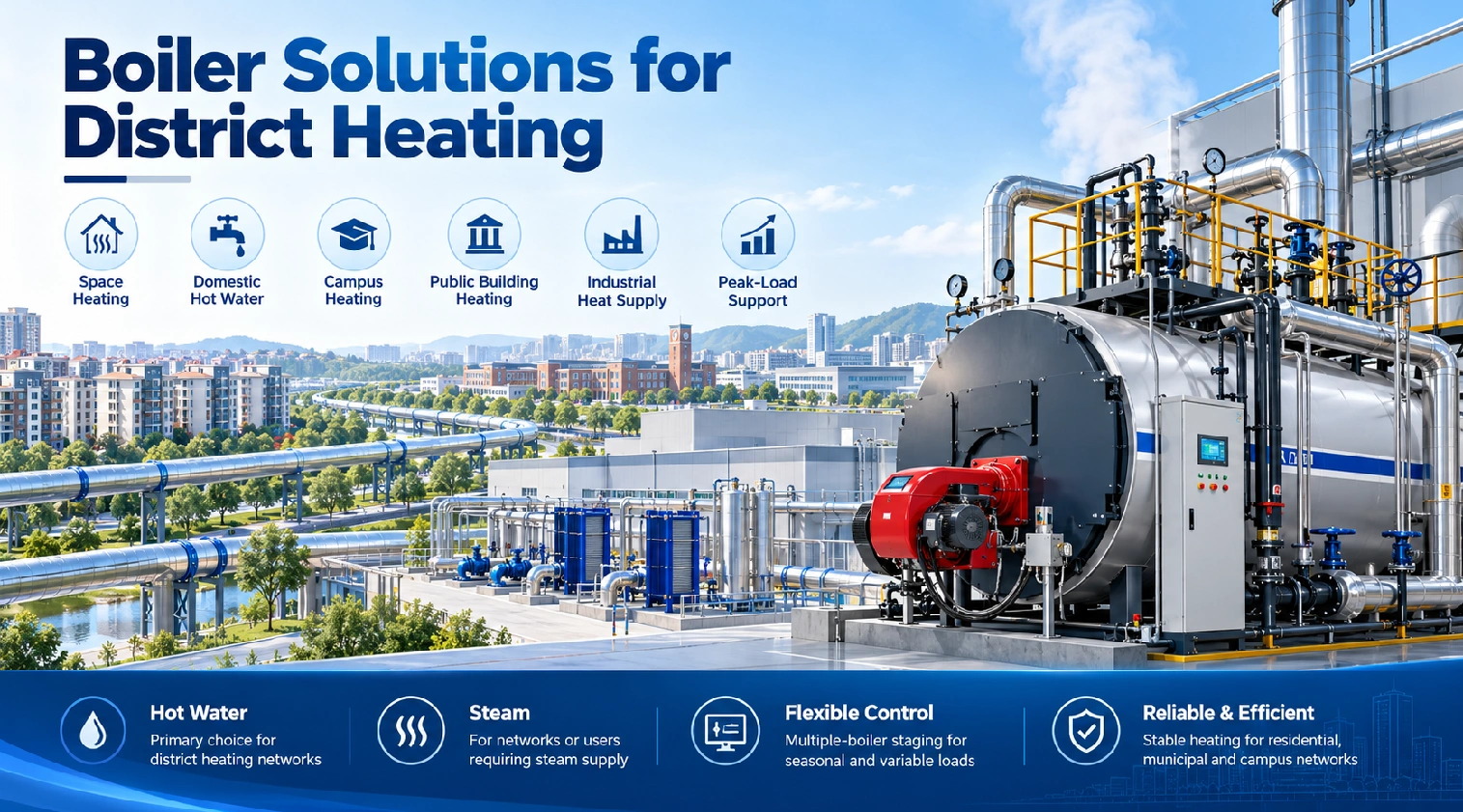
District heating systems depend on a reliable supply of hot water and, where required by the network or connected users, steam.
These heating media are commonly used for:
Space Heating · Domestic Hot Water · Campus Heating · Public Building Heating · Industrial Heat Supply · Peak-Load Support
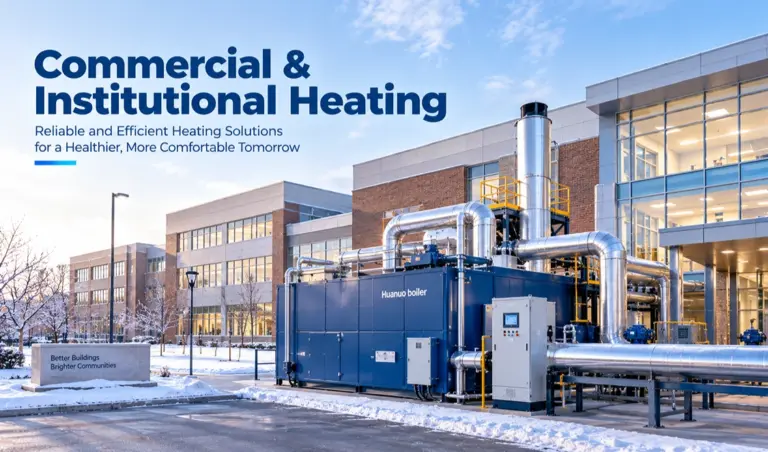
Huanuo Boiler provides customized heating solutions for municipal heating plants, residential communities, industrial parks, university campuses, hospitals, commercial complexes and other centralized heating networks.
For most district heating networks, hot water boilers are the primary choice for space heating and domestic hot water. Steam boilers are considered only where the network design or connected industrial users specifically require steam. Final selection depends on network temperatures, design pressure, heat load and operating strategy.
Recommended Boiler Selection
| Production requirement | Recommended Huanuo product | Typical application |
|---|---|---|
| General and stable hot-water demand | CWNS Series Gas/Oil-Fired Hot Water Boiler | Small and medium-sized district heating stations, residential blocks and commercial buildings |
| Large and continuous heating demand | SZS Series Gas/Oil-Fired Water-Tube Hot Water Boiler | Large centralized heating networks, industrial parks and multi-building campuses |
| Improved fuel utilization and lower emissions | Gas-Fired Hot Water Boiler with Project-Specific Flue-Gas Heat Recovery | Projects seeking to recover additional flue-gas heat, subject to the selected boiler configuration and operating conditions |
| Seasonal or variable heating demand | CWNS or SZS Series Hot Water Boilers in a Multiple-Boiler Configuration | Networks with changing outdoor temperatures, varying daily loads or summer domestic-hot-water demand |
| Reliable local biomass fuel available | SZL Series Biomass-Fired Hot Water Boiler | District heating projects with suitable biomass supply and appropriate fuel-handling and emission-control systems |
| Small heating load or no on-site combustion | W(L)DR Series Electric Hot Water Boiler | Small buildings, auxiliary heating or sites where electric heating is preferred and the available electrical supply is adequate |
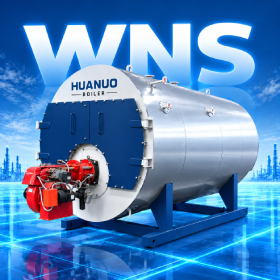
| Connected users specifically require steam | WNS Series Gas/Oil-Fired Fire-Tube Steam Boiler | Heating plants or connected industrial users whose system design requires steam rather than hot water |
| High reliability and standby capacity required | CWNS or SZS Series Hot Water Boilers in a Duty/Standby or Multiple-Boiler Configuration | Hospitals, residential networks and public facilities requiring continued heat supply during maintenance or peak demand |
The final solution should be selected according to the network heat load, supply and return water temperatures, working pressure, seasonal load profile, available fuel and applicable local requirements.
Key Considerations for Boiler Selection
01.Network Temperature and Pressure
Confirm the required heating capacity, supply and return water temperatures, design pressure and whether the system serves space heating, domestic hot water or industrial users.
Boiler selection should match the district heating network and heat-exchange arrangement. Circulation, expansion or pressurization equipment, controls and safety devices should be designed as part of the complete heating system.
02.Heating Capacity
Boiler capacity should be based on the calculated peak heat demand of the connected network—not simply the number of buildings or total floor area.
Consider building heat loss, local design outdoor temperature, domestic hot-water demand, network losses, diversity of demand, planned expansion and the required reserve capacity.
03.Seasonal and Variable Loads
District heating demand changes with outdoor temperature, time of day, occupancy and the heating season. Summer demand may be limited mainly to domestic hot water.
A multiple-boiler arrangement with staged control can help match output to changing demand, improve operating flexibility and support maintenance without unnecessarily operating one oversized boiler at low load.
04.Fuel and Operating Cost
Boiler selection should consider more than the initial purchase price.
Local fuel availability and prices, annual operating hours, seasonal efficiency, emission requirements, fuel-handling needs and maintenance costs all affect long-term operating cost.
05.Water Quality and System Reliability
Appropriate water treatment helps limit scale, corrosion and deposits. The system design should also account for make-up water, leakage control, expansion or pressurization, circulation and heat-exchanger requirements.
For heating networks serving homes and essential public facilities, consider reliable controls, preventive maintenance and suitable standby capacity. The required redundancy should be determined from the network’s service level and operating plan.